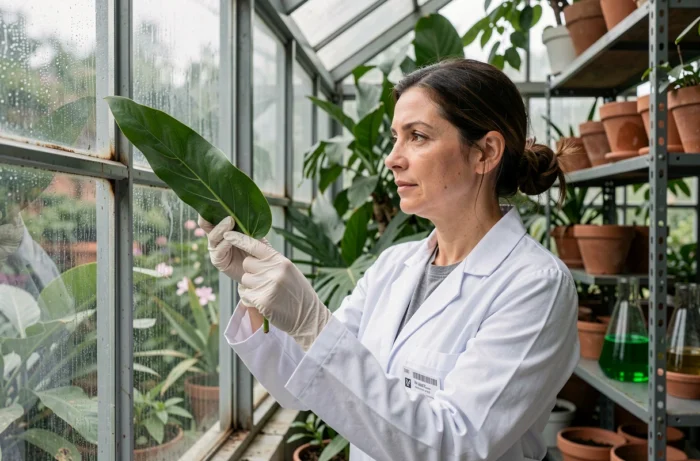
A plant sitting on a windowsill receives light and water, yet it also takes in an invisible gas every moment: carbon dioxide. This CO₂ in the surrounding air is the raw material plants convert into sugars to grow. Understanding how this gas contributes to photosynthesis helps explain why growing conditions have such a strong influence on a plant’s vigor.
Stomata and CO₂ uptake: the often-overlooked gateway
Before looking at the chemical reaction itself, it’s worth considering how CO₂ enters the leaf. Leaf surfaces are dotted with tiny openings called stomata. Each stoma acts like a valve: it opens to let carbon dioxide in and closes to limit water loss through transpiration.
This mechanism creates a constant trade-off. The plant balances carbon uptake against water conservation. When the concentration of CO₂ in the air rises, the stomata can partially close while still allowing enough carbon dioxide to enter. The leaf then loses less water, improving its water-use efficiency in the short term.
This water saving at the leaf level doesn’t guarantee that the plant will use less water over an entire season. Other factors, such as temperature, wind, and soil moisture, also come into play. To learn more about the role of CO₂ in plants, we need to look beyond the individual leaf and consider the whole organism in its environment.
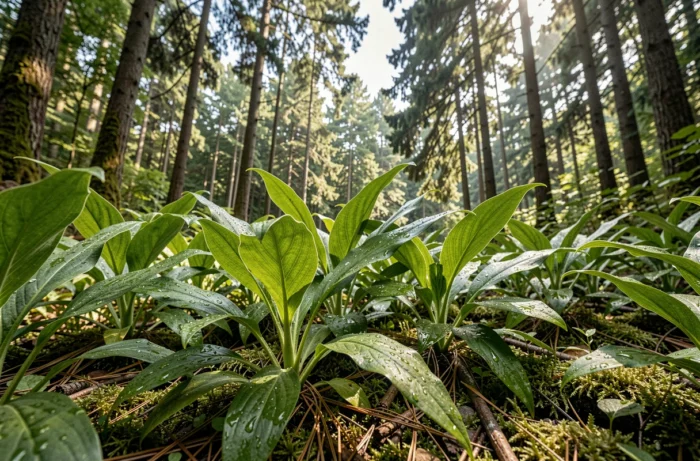
The Calvin cycle and carbon fixation in chloroplasts
Once CO₂ enters the leaf, it reaches the chloroplasts, the small green structures found in plant cells. This is where photosynthesis takes place in two main stages.
The light-dependent stage: capturing solar energy
The first stage depends directly on light. Chlorophyll pigments absorb solar radiation. This light energy is used to split water molecules, releasing oxygen and producing energy-rich molecules (ATP and NADPH). The oxygen we breathe comes from this breakdown of water, not directly from CO₂.
The light-independent stage: turning CO₂ into sugars
The second stage, known as the Calvin cycle, doesn’t require direct light but uses the energy produced in the previous stage. An enzyme called Rubisco fixes CO₂ onto a five-carbon molecule (ribulose bisphosphate). This reaction produces a three-carbon compound that is then converted into glucose and other sugars.
CO₂ provides the carbon atoms that make up the plant’s organic matter: stems, leaves, roots, and fruit. Without this supply of gaseous carbon, a plant simply cannot make the building blocks of its own structure.
In summary, the simplified equation is:
- Water + CO₂ + light = glucose + oxygen
- The carbon from CO₂ ends up in the sugars produced by the plant
- The oxygen released comes from the breakdown of water, not from carbon dioxide itself
C3 and C4 plants: responses to CO₂ vary by species
Have you noticed that some crops thrive in hot, dry environments while others prefer temperate climates? This difference is partly due to how each species fixes carbon.
Most plants, including wheat, rice, and fruit trees, are known as C3 plants. In these plants, the first compound formed after CO₂ fixation contains three carbon atoms. C3 plants benefit more from a rise in ambient CO₂ because their Rubisco enzyme captures the gas directly from the atmosphere.
Other species, such as corn, sugarcane, and sorghum, use a mechanism known as C4. They concentrate CO₂ around Rubisco through an additional biochemical step. This system makes them more efficient in hot, bright conditions, but the gains from increasing CO₂ concentrations are generally less pronounced than in C3 plants.
Water stress can alter this response. When water is scarce, stomatal closure limits CO₂ uptake in all plants. In this situation, even C4 plants can benefit from higher atmospheric concentrations, since a stronger CO₂ gradient drives more gas through partially closed stomata.
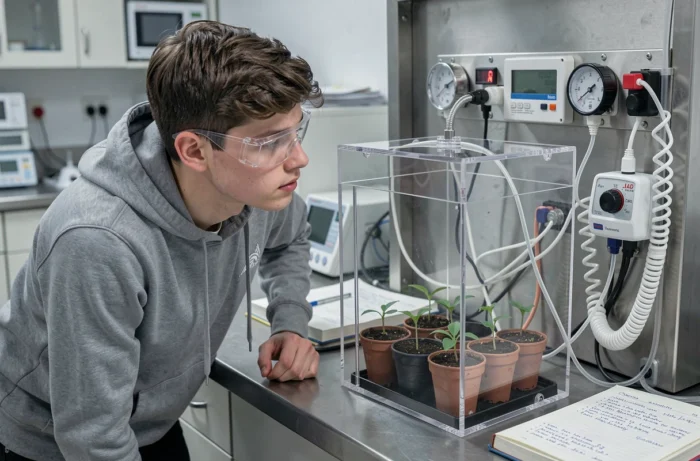
Does more CO₂ always mean more growth?
Increasing CO₂ levels in a greenhouse often speeds up photosynthesis. This has led many greenhouse growers to enrich the air around their crops with carbon dioxide. The increase in sugar production at the leaf level is real.
The effect on the whole plant is less straightforward. Several factors can limit the response:
- Photosynthetic acclimation: after a few weeks at elevated CO₂, some plants reduce their capacity to fix carbon, as if they were “getting used to” the surplus
- Nutrient limitations: without enough nitrogen or phosphorus, the plant cannot build the proteins and membranes needed to make use of the additional carbon
- Sugar transport: if the plant produces more glucose than it can distribute to its tissues, the excess builds up in the leaves and slows photosynthesis through feedback
Assimilating more carbon doesn’t automatically mean producing more harvestable biomass. A plant that produces a lot of sugar may store it in its roots rather than its fruit, or slow its carbon fixation because it lacks other essential resources.
This is a reminder to think of CO₂ as one of several factors in plant growth. Light, water availability, temperature, and soil fertility all contribute to a set of conditions in which none can compensate on its own for the absence of the others. CO₂ is the raw material for plant organic carbon, but turning that raw material into a harvest depends on the overall balance of resources.