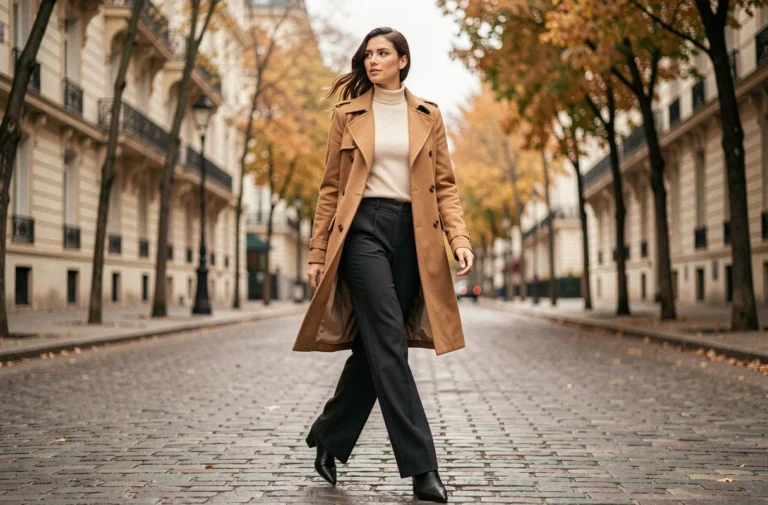
In the mid-1990s, fashion went through a period of creative tensions rarely as visible on the runways. In 1995, the Parisian, Milanese, and London shows crystallized opposing currents that coexisted without neutralizing each other. Grunge at the end of its cycle, techno-industrial minimalism, structured glamour: these directions did not follow one another; they overlapped within the same season.
Techno-minimalist futurism: nylon as a manifesto at Prada
The minimalism of 1995 is not limited to sober cuts on noble fabrics. At Prada, the approach incorporates nylon, technical materials, and details borrowed from industrial sportswear. This approach is distinctly different from the clean tailoring of Jil Sander, which focused on the neutrality of volumes and the fluidity of lines.
The gap between these two visions highlights a rarely articulated divide at the time. Prada combined clean cuts and industrial materials, creating an aesthetic that anticipated the utilitarian relationship to clothing as found in contemporary fashion. Jil Sander, on the other hand, conceived minimalism as a deliberate erasure of the body’s forms under ample, neutral volumes.
To discover the must-haves of 1995 fashion, this duality serves as a more precise entry point than the simple label “90s minimalism” often applied to the entire decade.

Alexander McQueen and the torn tartan: fashion as political narrative in 1995
Alexander McQueen’s autumn-winter 1995 show went beyond aesthetic provocation. The torn tartans and deliberately distressed tailoring were not merely gratuitous punk gestures. McQueen embedded his garments within the historical tensions between England and Scotland, transforming the runway into a space of political memory.
This positioning contrasted sharply with the dominant commercial logic of major fashion houses. While Versace or Dolce & Gabbana constructed seductive glamour intended for the party scene, McQueen imposed a vocabulary of clothing laden with history and symbolic violence.
A tailoring that refuses perfection
The most revealing detail lies in the treatment of the men’s suit. McQueen retained the structure of British tailoring (sharp shoulders, fitted waist) while sabotaging it with tears, visible stitching, and raw finishes. This formal paradox had no equivalent on the 1995 runways. It posed an open question: can a garment carry a political discourse without becoming a costume?
Grunge, baggy, and street codes: the end of an initial cycle
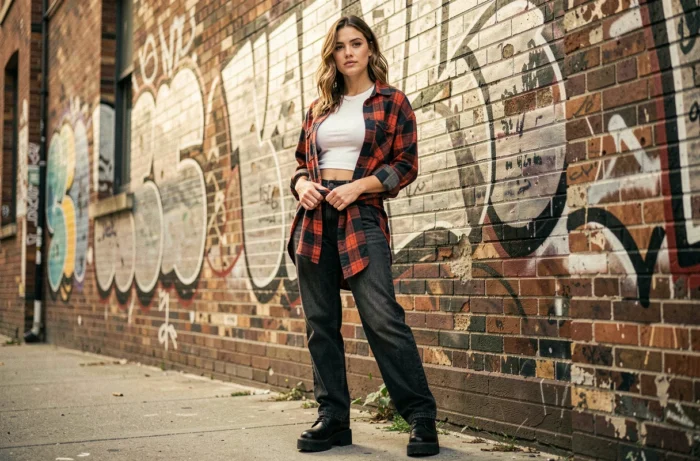
By 1995, the grunge that Marc Jacobs had introduced on the runways a few seasons earlier began to lose its subversive charge. Flannels, boots, and careless layering appeared in mainstream collections, a sign of rapid absorption by the market.
The baggy style illustrates a parallel phenomenon. Popularized on the streets, particularly in San Francisco and hip-hop communities, the baggy jeans of 1995 embodied a rejection of the fitted silhouettes that had dominated the previous decade. Their appropriation by designers followed a classic pattern: appropriation, stylization, then dilution of the original gesture.
- Oversized flannels and thick-soled boots signaled a relationship to clothing based on comfort and detachment, not seduction
- The baggy style functioned as a community code before becoming a commercially marketed wardrobe staple
- French designers integrated these codes with a temporal lag, with the Parisian collections of 1995 blending grunge influences and more classic references to French tailoring
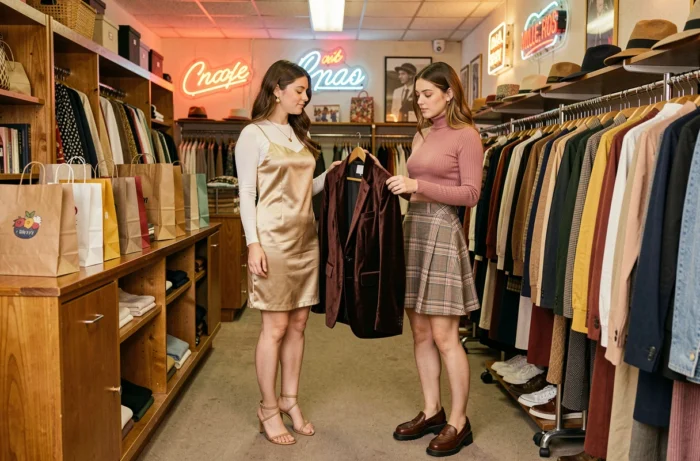
Two relationships to the body on the 1995 runways: Jil Sander vs. Versace
The most defining opposition of that year remains between two conceptions of the relationship to the female body. Jil Sander’s minimalism concealed forms under fluid volumes, proposing a wardrobe designed for the professional environment and discretion. Versace, in contrast, emphasized curves with form-fitting cuts, bright colors, and shiny materials intended for the nightlife scene.
This opposition is not merely a difference in taste. It corresponded to distinct audiences, different contexts of wear, and ultimately, two visions of the social role of clothing. Field feedback diverged on this point: some critics of the time saw minimalism as a form of puritanism, while others interpreted it as an emancipation from the injunction to seduction.
An inheritance taken up by Miu Miu and Prada in the 2020s
The contemporary reception of 1995 goes beyond the simple return of grunge or baggy styles. Miu Miu and Prada have incorporated elements associated with the minimalism of the mid-1990s into their 2022 collections: micro-skirts, short cardigans, and silhouette proportions characteristic of that period. The reference to 1995 no longer functions as nostalgia but as a technical citation, with current designers isolating specific details rather than reproducing a generic “90s look.”
- The micro-skirts referenced by Miu Miu cite a silhouette proportion specific to the mid-decade, not a global style
- The short cardigans and technical materials refer to Prada’s futurism rather than grunge
- This sharp selection distinguishes the current revival from the more superficial waves of nostalgia of the 2010s
The fashion of 1995 remains a field of study because it condenses, in a single season, contradictory directions that continue to fuel contemporary creation. The fact that houses like Prada draw from their own archive of this period, extracting very targeted elements, suggests that the year 1995 functions as an active reservoir of forms rather than as a simple closed chapter in the history of clothing.