
Delimiting your land without a fence requires mastering both the local regulatory framework and the techniques for marking the ground. We observe that recent local urban plans (PLU) are tightening constraints on opaque fences (solid walls limited to 1.60 m on the street and 1.80 m internally in several municipalities), which drives many property owners towards alternative delimitation solutions.
Contradictory boundary marking and property lines: securing an open land
An open land visually does not mean a land without legal boundaries. The amicable contradictory boundary marking, carried out by a surveyor, remains the only act enforceable against third parties to establish the separating boundary. The resulting report describes the material signs retained (standardized markers, stakes, large stones) and is registered in the land registry.
We systematically recommend this approach before any marking, even vegetative. Without boundary marking, a low wall, a planted strip, or a simple change of surface laid a few centimeters from the true boundary exposes you to the same encroachment risk as a poorly placed fence. The cadastral map, let us remember, has no legal value for setting boundaries between parcels: it is a fiscal document, not a property plan.
The interest of contradictory boundary marking in a fence-free strategy is precisely to keep the land open while having formal proof. If a neighbor ever contests the position of a low hedge or a border, the report resolves the issue without recourse to the court, provided it has been signed by both parties. To delve deeper into the practical implementation of these delimitations, Agrisystems.net’s practical advice details several configurations suitable for both rural and urban lands.
Materials and techniques for delimitation without rigid fencing
Alternatives to traditional fencing fall into three categories: vegetative, mineral, and mixed. Each responds to distinct technical constraints depending on the nature of the soil, exposure, and applicable PLU.
Low hedges and planted strips
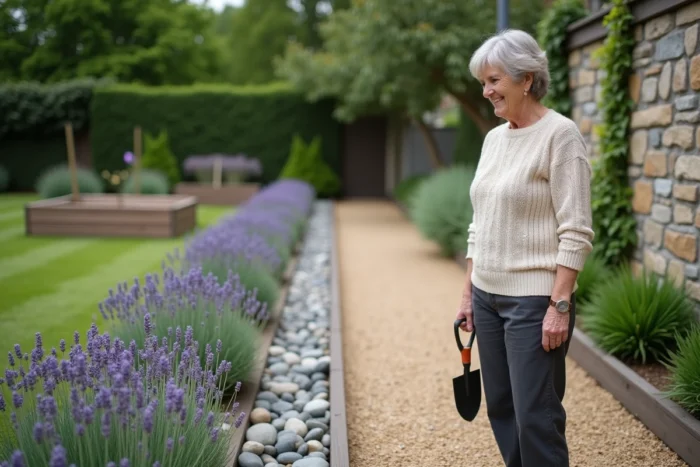
A hedge trimmed to a reduced height (below the thresholds imposed by the PLU) visually delineates without creating an obstacle. Evergreen species such as boxwood, lonicera nitida, or yew allow for marking all year round. The planted strip in the ground is often required by recent regulations, making it a doubly compliant solution.
The classic trap: planting too close to the separating boundary. Article 671 of the Civil Code imposes a minimum planting distance from the boundary (variable depending on the adult height of the species). Without prior boundary marking, this distance is calculated blindly.
Borders and changes in ground surface
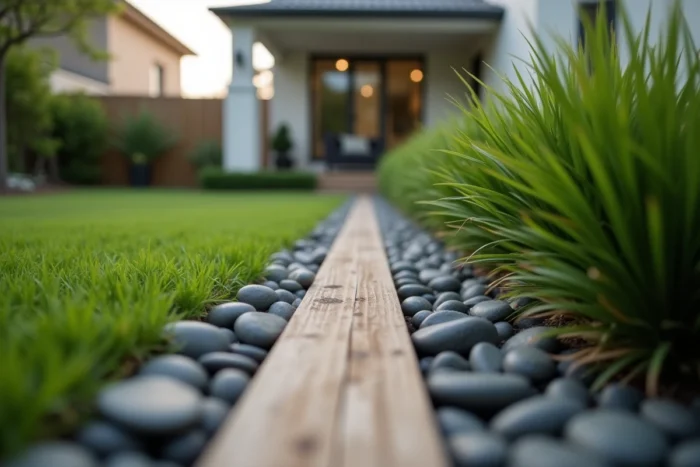
A clear transition between two materials (gravel/lawn, paving/soil, slabs/bark) creates a readable boundary without verticality. This technique works well on flat lands. On a sloped land, a low retaining wall replaces the border and ensures both soil retention and visual delimitation.
- Corten steel or aluminum border: discreet profile, anchored by driven stakes, corrosion resistance varies depending on the chosen material
- Dry stone or low gabion wall: suitable for sloped lands, natural appearance, requires rear drainage to avoid hydrostatic pressure
- Row of low posts connected by a horizontal rail in wood or aluminum: intermediate solution between fencing and simple marking, often accepted in restrictive PLUs
Lighting and furniture as boundary markers
Low light posts installed along the separating boundary create a night and day reference point. This approach, more common in contemporary landscaping, combines delimitation and garden lighting. The electrical connection must remain entirely on your parcel, which again requires knowing the exact boundary.
PLU constraints and legal risks of non-compliant delimitation
Your municipality’s PLU may impose specific obligations even in the absence of a strict fence. Some regulations require a setback obligation from the public road for any development at the property boundary, including a low wall or hedge.
A non-declared delimitation development can lead to the same penalties as a non-compliant fence. In dense urban areas, prior declaration of work is required for any structure altering the external appearance of the land, even a simple wall a few tens of centimeters high.
- Check the PLU or subdivision regulations before any development, even vegetative
- Consult the town’s urban planning department to confirm allowed heights and setbacks
- Keep the boundary marking report and the surveyed plans for any future disputes
A discreet development does not exempt from prior declaration if the PLU requires it. We find that this mistake remains the most frequent among owners who believe that a border or low hedge escapes any administrative control.
Maintenance and longevity of delimitations without a fence
Vegetative solutions require regular trimming to remain below the PLU thresholds. A hedge that exceeds the authorized height loses its status as a soft delimitation and may be reclassified as a fence, with associated obligations.
Metal borders made of corten steel develop a protective patina, but those made of lacquered aluminum require checking the fixings after each winter. Dry stone walls require occasional joint repairs if the land shifts. The longevity depends on the initial choice of material suitable for the soil: a gabion on swelling clay without drainage will eventually deform in a few years.
Delimiting without rigid fencing offers appreciable aesthetic and regulatory flexibility, provided one does not confuse visual lightness with legal lightness. Contradictory boundary marking remains the foundation of any delimitation strategy, with or without a physical barrier.