Receiving mail at a non-buildable plot of land involves solving two distinct problems: obtaining a usable postal address and installing a mailbox that complies with La Poste’s delivery requirements. These two conditions do not depend on the same parties, and their feasibility varies according to the location of the land, its accessibility, and the municipal regulations in force.
Postal address on non-buildable land: what La Poste concretely requires
The most common misconception is that a non-buildable plot cannot have an address. The classification as a non-buildable zone by the Local Urban Planning Plan (PLU) prohibits the construction of permanent buildings, but it does not eliminate the possibility of identifying a postal delivery point.
For La Poste to deliver mail, three elements must coexist: a number on the road or a location supplement (place name, distribution point), a readable identification on the mailbox, and an installation accessible from the road. Article D90 of the Postal Code specifies that the operator is only required to deliver mail if an accessible mailbox exists at the address. Otherwise, shipments may be held or returned to the sender.
The question of whether one can receive mail at a non-buildable plot thus depends less on urban planning law than on the material conditions of postal delivery.
| Criteria | Buildable land with building | Non-buildable land |
|---|---|---|
| Automatically assigned address | Yes (upon building permit) | No, procedure with the town hall required |
| Road numbering | Assigned by the municipality | Possible if the land borders a municipal road |
| Authorized mailbox | Yes | Yes, subject to accessibility conditions |
| Delivery by La Poste | Guaranteed if compliant mailbox | Conditioned on access from a drivable road |
| Administrative domiciliation | Yes | Frequent refusal without declared residence |
Accessibility of the land: the criterion that blocks postal delivery
The main obstacle is not legal but physical. Recent cases reported by local media show that La Poste refuses delivery when mailboxes are too far from the road or difficult to access, even if the land is served. In Marseille, residents found themselves deprived of mail for this reason.
For non-buildable land, the situation often becomes more complicated. These plots are frequently located in agricultural, natural, or forested areas, sometimes without direct access to a drivable road. The mail carrier has no obligation to leave their vehicle to traverse a dirt path for several hundred meters.
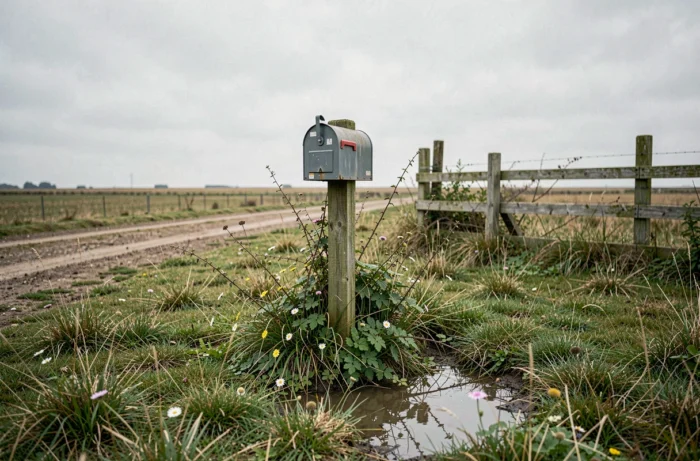
The most common solution is to install the mailbox at the edge of the public road, at the closest point accessible by the delivery vehicle. This installation does not require a building permit, but it must comply with current standards:
- The mailbox must bear the recipient’s name in a legible manner, in accordance with La Poste’s requirements for identifying the delivery point
- It must be positioned at a height and location allowing the mail carrier to access it without leaving their vehicle or departing from the roadway
- The owner must obtain the town hall’s approval if the mailbox is placed on public land or directly adjacent to it
Obtaining a road number on non-buildable land: procedure with the town hall
Without a road number, there is no usable address. On buildable land, this number is assigned during the processing of the building permit. On non-buildable land, no automatic mechanism exists.
The request is made directly to the town hall. The municipality has the authority to number the roads within its territory. Nothing in the law prohibits assigning a number to a non-buildable plot, but the town hall may refuse if the land does not border a named municipal road or if no delivery justifies this assignment.
In practice, plots located in a place name often benefit from sufficient geographical identification for La Poste to accept delivery. The location supplement (name of the place name, sometimes a cadastral reference) then replaces the standard street number.
Domiciliation and non-buildable land: the administrative limit
Receiving mail and establishing one’s residence are two distinct processes. Administrative domiciliation generally requires a declared residence, which poses a problem on land where no permanent construction is allowed.
Owners who live on their non-buildable land (yurt, tiny house, light housing) regularly encounter this blockage. The town hall may refuse to register them on the electoral rolls or issue them a certificate of residence at this address, due to the lack of housing recognized by urban planning law.
Two alternatives exist to circumvent this difficulty without breaking the law:
- Domiciliation with a third party (family, friend) who has a recognized address, while receiving daily mail at the plot via a compliant mailbox
- The Poste restante service offered by La Poste, which allows one to collect their mail at the nearest post office without needing a fixed address
- For businesses, using a commercial domiciliation company that provides an administrative address distinct from the actual place of activity
Receiving mail at a non-buildable plot remains possible as long as the material requirements of La Poste are met. The accessibility of the mailbox from a drivable road determines feasibility much more than the urban classification of the land. Administrative domiciliation, however, remains the real point of friction for those considering residing there.