What distinguishes a skipper capable of completing a solo circumnavigation from those who abandon before Cape Horn? The answer lies less in courage than in a measurable combination of technical, physical, and strategic factors. The journey of a legendary skipper around the world can be read in the race data, boat choices, and performance gaps between generations of sailors.
IMOCA Monohulls vs. Ultim Trimarans: Two Visions of the Solo Round-the-World Race
The solo round-the-world race is no longer limited to the Vendée Globe and its 60-foot IMOCA monohulls. Since the first edition of the Arkea Ultim Challenge in 2024, the 32-meter Ultim maxi-trimarans have opened a new technological stage for the round-the-world race.
| Criterion | IMOCA (Vendée Globe) | Ultim (Arkea Ultim Challenge) |
|---|---|---|
| Type of boat | 60-foot monohull | 32-meter trimaran |
| Mode | Solo, non-stop, unassisted | Solo, non-stop |
| Reference time (best) | About 70-80 days depending on the editions | Less than 60 days for the leaders |
| Average speed of leaders | Around 14-15 knots | Close to or exceeding 18 knots |
| Sailing | Classic displacement + foils | Extended foiling |
| Iconic skippers | Jean Le Cam, Arnaud Boissières, Yves Parlier | Charles Caudrelier, Thomas Coville, Armel Le Cléac’h |
The average speed gap between the two formats exceeds three knots. Translated into a round-the-world journey, this represents several weeks less at sea. The path of a skipper on an Ultim involves managing foiling that did not exist ten years ago, with radically different mechanical reliability constraints.
To follow the complete journey of one of the most experienced skippers in French sailing, the page https://www.jeanlecam.fr/ outlines his participations in the Vendée Globe and major ocean races.
Sleep Management and Solitude: The Invisible Factors of a Solo Round-the-World Journey
Content about legendary skippers often focuses on storms and breakdowns. Recent data on the cognitive performance of sailors in prolonged isolation tell a different story.
A survey conducted among over 1,200 sailors showed that solitude weakens work engagement by eroding cognitive flexibility, inhibitory control, and working memory. For a skipper alone for several weeks around the world, these effects translate into navigation errors, degraded routing decisions, and a reduced ability to react to breakdowns.
What Cognitive Fatigue Changes in Racing
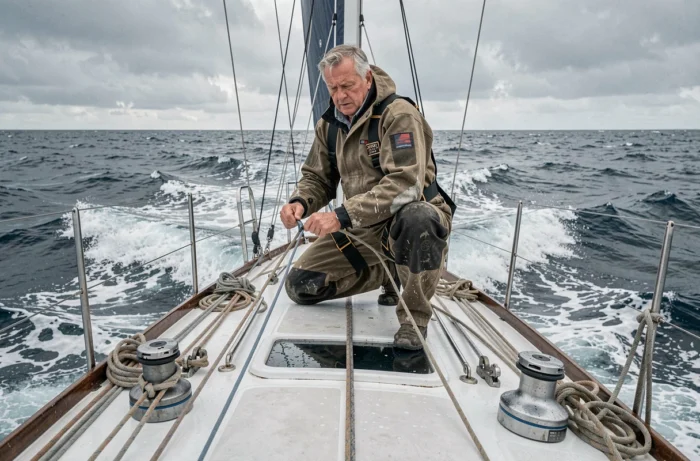
A Vendée Globe skipper sleeps in chunks of twenty to thirty minutes. This fragmentation, maintained over several months, progressively alters the ability to process complex weather information.
- Decreased cognitive flexibility makes it harder to quickly adapt to a change in weather systems, a determining factor in the Southern Oceans
- Weakened inhibitory control leads to uncalculated risk-taking, such as keeping too much sail up in a gust instead of reducing
- Degraded working memory complicates the simultaneous tracking of multiple parameters (heading, speed, boat condition, competitors’ positions)
Skippers who finish the round-the-world race are not those who sleep the least. They are the ones who protect their sleep as a strategic advantage, even if it means losing a few miles to a direct competitor.
Arkea Ultim Challenge 2024: What the New Race Reveals About the Evolution of the Skipper Around the World
The Arkea Ultim Challenge has reshaped the benchmarks of offshore racing. Charles Caudrelier on Maxi Edmond de Rothschild, Thomas Coville on Sodebo Ultim 3, and Armel Le Cléac’h on Banque Populaire XI completed this round-the-world journey in times approaching crewed records, all while sailing solo.
Mechanical Reliability: The True Selection Filter
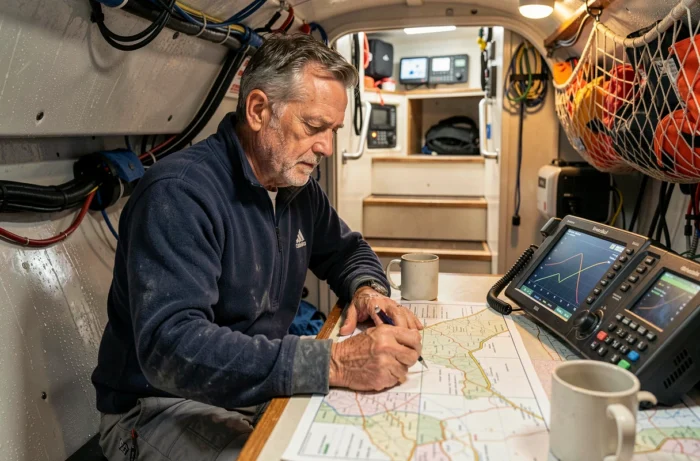
On an Ultim trimaran, foiling at over 30 knots for weeks exposes every component to structural stresses unmatched in monohulls. The reliability of the boat is as important as top speed.
A legendary skipper on an Ultim is not just a fast sailor. He manages a complex mechanical system in total autonomy, without a technical team on board. In contrast, an IMOCA from the Vendée Globe is more forgiving of steering errors due to its intrinsic stability as a monohull.
Routing Strategy and Weather
The speed of the Ultims changes the weather strategy. A trimaran moving at an average of 18 knots crosses low-pressure systems faster than a monohull. The skipper has shorter decision windows: every routing choice commits the boat to a trajectory that is difficult to correct at this speed.
Conversely, an IMOCA skipper can afford to wait for a weather evolution, to slow down deliberately, or to choose a longer but safer route. This difference explains why some sailors excel in one format and not the other.
Vendée Globe and Longevity: The Case of Skippers Who Return Edition After Edition
The Vendée Globe includes skippers who have participated in four, five, or even six editions. This longevity is often an underestimated performance indicator compared to speed records.
A sailor who completes multiple solo non-stop circumnavigations accumulates a wealth of experience that cannot be replicated otherwise. He knows the pitfalls of the Doldrums, the currents of Cape of Good Hope, the ice of the Southern Ocean.
- Knowledge of the intertropical convergence zones helps limit hours lost in the equatorial calms
- Experience with Southern Ocean depressions aids in choosing between going around or crossing a weather system
- Mastery of at-sea repairs (rigging, keel, electronic systems) distinguishes those who finish from those who abandon
Finishing the Vendée Globe is already a statistical achievement, as a significant portion of the skippers at the start do not reach the finish in Les Sables-d’Olonne. Returning multiple times places a sailor in a unique category, where consistency weighs more than the brilliance of a single race.
The next edition of the Vendée Globe will continue to measure this tension between pure speed and long-term endurance. Data from the Arkea Ultim Challenge shows that the solo round-the-world race is now played out on two distinct fields, with skipper profiles that do not always overlap.