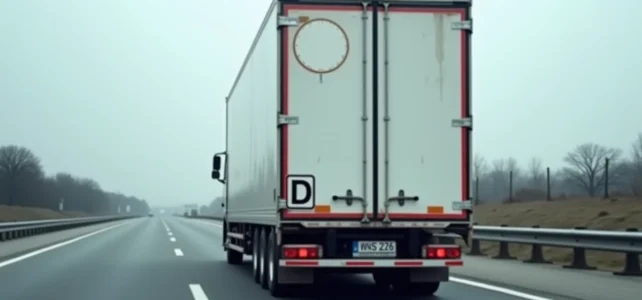
The letter D displayed on a truck does not have a unique and universal meaning. Depending on the country, local regulations, or the type of transport, this marking can refer to very different obligations: vehicle size, nature of the goods transported, or even the country code of registration. This plurality of meanings is rarely explained, and many drivers or road users perceive only one aspect of it.
Size marking: the letter D on wide vehicles
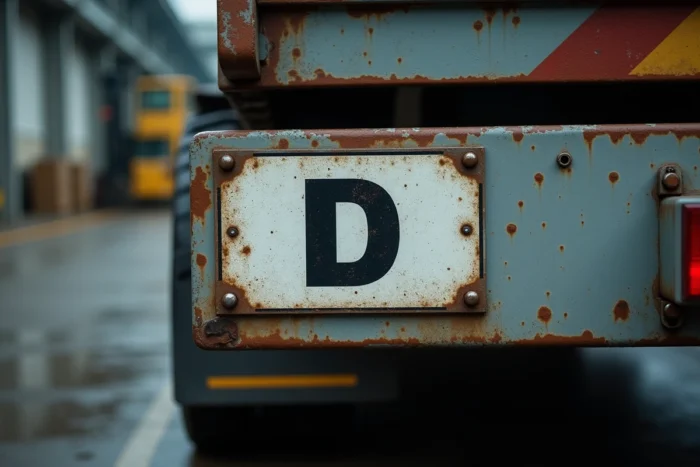
In several legislations, the letter D indicates a vehicle whose width exceeds the standard norm. The principle is simple: a truck, agricultural machine, or public works vehicle that exceeds 2.50 m in width must display a square sign showing a white D on a black background. This sign must be visible from the front and the rear, at a sufficient distance to alert other users.
The sign is illuminated as soon as night falls. The minimum height of the letter is set at 0.20 m in certain decrees, ensuring correct readability even from a distance. If the front sign is not visible from the rear of the combination (in the case of a vehicle towing a trailer), the last towed element must also display a D of the same dimensions.
To understand what the letter D means on a truck in this specific context, it is important to remember that this marking is primarily a road safety device intended to prevent risks associated with the crossing or overtaking of a bulky vehicle.
Vehicles equipped with special lights for slow-moving machinery may be exempt from this sign, as their lighting already serves the alert function.
Letter D on trucks: other regulatory meanings
Reducing the letter D to just the issue of size would be a mistake. Several uses coexist in road transport.
- The D as a country code: on European roads, a white oval sticker bearing the letter D identifies a vehicle registered in Germany (Deutschland). This marking, inherited from international traffic conventions, remains common on heavy goods vehicles crossing multiple borders.
- The D related to waste transport: in certain national or sectoral contexts, the letter D may indicate that the truck is transporting waste subject to specific regulations. This marking sometimes conditions access to certain areas or treatment facilities.
- The D on the automatic transmission: on the gear lever of a utility vehicle or truck equipped with an automatic transmission, the position D (Drive) designates normal driving mode. This is not an external marking, but confusion exists among non-professionals.
The common point among these uses is that each responds to a specific standard or convention. None is decorative.
Legal implications of the D marking in road transport
In France, as in other countries, the presence of certain markings on a truck determines its legal compliance. A vehicle that should display the D sign and does not is subject to sanctions during road checks. The marking can also determine the authorization to use certain roads, particularly those where size is limited.
This legal dimension goes beyond simple visual signaling. The compliance check of a heavy vehicle includes verifying regulatory signs, just like checking the brakes, engine, or transport certificate. A carrier who neglects these markings risks having the vehicle immobilized.
Connection with other mandatory markings
Markings on trucks are regularly evolving. Since November 1, 2024, for example, tires recognized for the Mountain Law must bear the 3PMSF marking, as the M+S alone is no longer sufficient. This evolution illustrates that visible indications on a vehicle have a concrete and changing regulatory significance.
In the same way, the CMR waybill (Convention on the Contract for the International Carriage of Goods by Road) accompanies cross-border deliveries. The driver must be able to present this document during any inspection. Physical markings on the vehicle and onboard documents form a coherent set that authorities check simultaneously.

Why the letter D remains misunderstood by users
The confusion arises from the fact that the letter D is not defined by any single global convention. Its meaning depends on where it is placed (bodywork, bumper, gear lever), its size, its support, and the country of circulation.
A motorist encountering a truck bearing a large white D on a black background is dealing with an oversized vehicle. A D in a white oval on a heavy vehicle in transit indicates the country of origin. The two situations do not require the same vigilance or response on the road.
For transport professionals, the distinction is clear. The driver knows which marking concerns their vehicle and what obligations arise from it. For other users, remembering a practical rule is sufficient: a black D on a lit square sign indicates a vehicle wider than normal, and justifies an increased safety margin when crossing or overtaking.
The D marking, whatever its variation, contributes to a system where each visible indication on a truck has a precise regulatory or informative function. Ignoring its meaning means missing a signal designed to protect all road users.