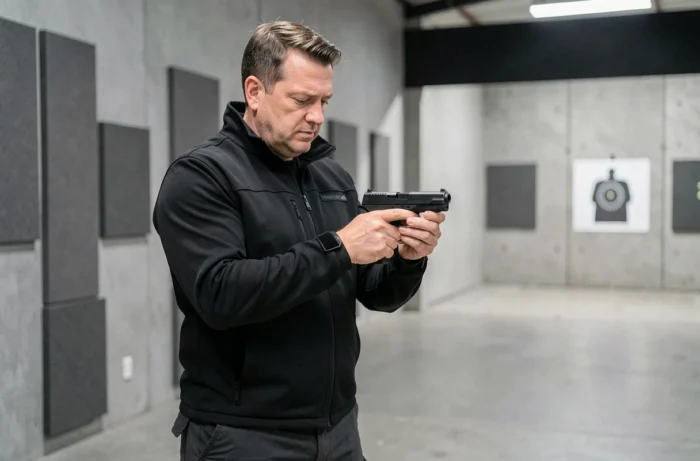
In the John Wick saga, every weapon tells part of the story. The first film features an arsenal close to standard configurations, while the later chapters introduce increasingly customized models, designed to serve the filmmaking as much as the narrative. This gradual shift from standard weapons to custom pieces is an artistic choice rarely analyzed outside specialist circles.
Sealed barrels and digital muzzle flashes: how safety affects realism
Have you ever noticed that the shell casings ejected on screen sometimes look too clean, too uniform? That’s often because they aren’t physically present on set.
Chad Stahelski, the saga’s director, favors sealed barrels with muzzle-flash effects added in post-production for weapons supplied by 87Eleven Productions. In practice, the actor handles a weapon that cannot fire. The muzzle flash, smoke, and visible recoil are recreated digitally, frame by frame.
This process comes at an artistic cost. A weapon’s natural recoil affects the shooter’s stance, the tension in their arms, and the slight imbalance after each shot. When everything is simulated, the actor has to compensate through body language. That’s where Keanu Reeves’s intensive training really pays off: he reproduces a real shooter’s subtle reactions without the weapon’s mechanical feedback.
The safety benefits, however, are considerable. Following several serious accidents on Hollywood sets involving blank ammunition, using digital effects reduces risks without sacrificing the clarity of the action. The audience sees a convincing shot, and the set stays safe.
John Wick’s weapons: from standard Glock to custom models
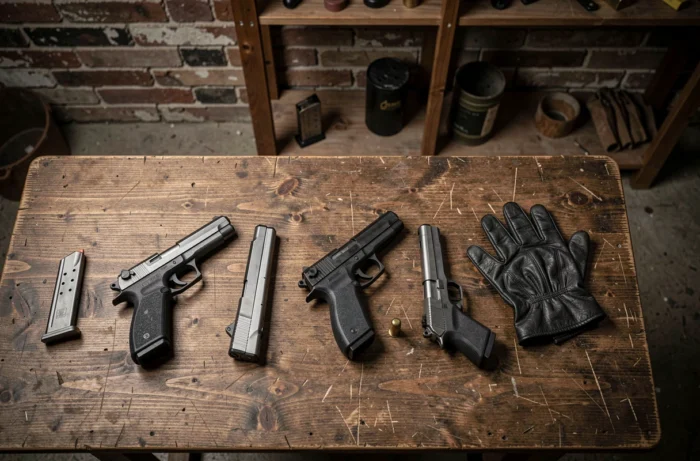
The first chapter features a recognizable arsenal. The Glock, one of the world’s most widely used semi-automatic pistols, appears in an almost standard configuration. Every weapon chosen for John Wick’s weapon in the first film fits the image of a professional hitman who relies on dependable, understated gear.
Starting with Chapter 2, the approach changes. The weapons feature visible modifications: extended barrels, compensators, and specialized sights. These additions aren’t just decorative. A compensator reduces muzzle rise after a shot, allowing the shooter to move between targets more quickly. On screen, this makes the action sequences flow more smoothly, as the character moves from one opponent to the next without a pause.
The Pit Viper: a bridge between competitive shooting and cinema
The clearest example of this back-and-forth between the real world and fiction is the Pit Viper. This weapon, associated with John Wick in Chapter 4, had been introduced by Taran Butler at the 2021 USPSA 2-Gun Championships, long before its cinematic debut.
Its journey is unusual: a weapon designed for competitive shooting, tested under real championship conditions, then featured in a blockbuster. Usually, it works the other way around. A film popularizes a weapon, and competitive shooters take an interest in it afterward. With the Pit Viper, cinema drew directly from the competitive shooting world.
Dragon’s breath shotgun in Chapter 4: spectacle or ballistic realism?
Chapter 4 takes the spectacle up a notch with a dragon’s breath shotgun sequence. This type of ammunition projects incandescent particles several meters, creating a visible jet of flame. A review published by The Associated Press on March 25, 2023, cites this sequence as one of the film’s standout moments.
Why choose it? Dragon’s breath ammunition has virtually no tactical value. Its effective range is very short, its accuracy is poor, and it poses a major fire hazard. Here, the spectacular weapon serves the choreography, not realism.
It’s a deliberate shift for the saga. In the first film, audiences could believe the arsenal was plausible. By the fourth, weapons have become filmmaking props, just like the lighting or the set. The question is no longer, “Would this weapon be used in a real-life situation?” but “Does this weapon create the most striking image possible?”
Keanu Reeves’s training: weapons as tools of choreography
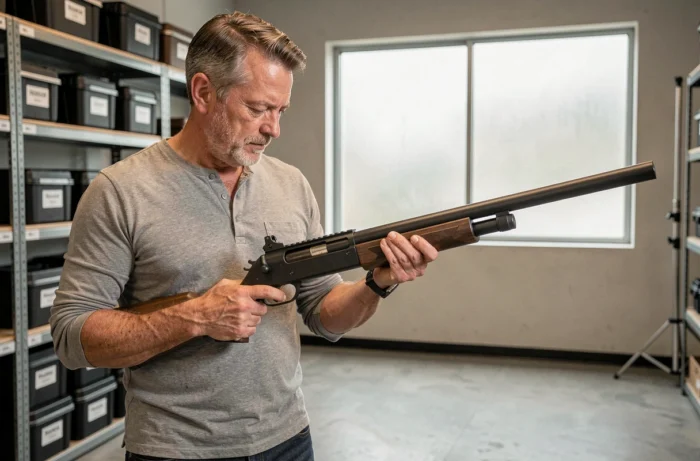
An assault rifle weighs several kilos. Holding it in a firing position for hours on set requires specific physical preparation. For Chapter 4, Keanu Reeves spent months training with firearms, an investment that goes far beyond learning how to shoot.
The goal isn’t ballistic accuracy. It’s clarity. Every reload, every transition between handgun and rifle, every holstering movement has to be performed at exactly the right pace so the camera can follow without a cut. Weapons function like dance props: their weight, bulk, and mechanisms dictate the rhythm of the scene.
Three elements set this approach apart from a basic shooting course:
- “Gun-fu” combines martial arts and weapons handling in a single sequence, requiring a shift from hand-to-hand combat to shooting in a fraction of a second
- Weapon transitions (pistol to rifle, rifle to knife) are choreographed down to the smallest movement to avoid visual pauses
- Tactical reloading is built into the action and filmed in a continuous shot to heighten immersion, leaving no room for hesitation from the actor
This preparation explains why the saga’s action scenes feel different from those in other films. The realism comes not from the weapons themselves, but from the physical mastery of the person wielding them.
Over the course of four chapters, the John Wick saga has turned its weapons into fully fledged narrative elements. From the understated Glock in the first film to the spectacular dragon’s breath in the fourth, each arsenal choice reflects a shift in tone. Sealed barrels and digital effects have replaced some of the mechanical realism with controlled visual realism—safer and, paradoxically, more cinematic.