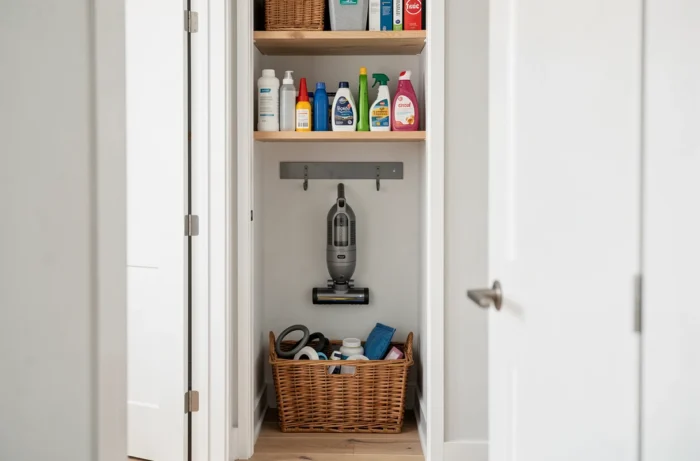
A canister vacuum stuck between two buckets, a broom that falls every time you open the door, accessories scattered on a shelf: the utility closet quickly becomes a space of frustration. Storing a vacuum in a closet is not just about pushing it to the back. The choice of location, vertical organization, and type of device directly affect the space available for the rest of your cleaning products.
Emptying stations and integrated towers: game-changing storage
Recent stick vacuums are revolutionizing the broom closet logic. Models like the LG CordZero All-in-One Tower combine charging, automatic dustbin emptying, and accessory storage in a single vertical unit. Such a tower alone replaces the wall hook, brush shelf, and charging outlet.
The direct consequence: the closet no longer needs to house the vacuum. The tower can be installed in a hallway, a laundry corner, or even in the living area. If you consider this type of device, just plan a fixed location with a nearby electrical outlet.
For canister vacuums or stick models without a station, the closet remains the most common solution. Several vacuum storage methods allow you to save space without sacrificing accessibility.
Utilizing closet height with wall mounts
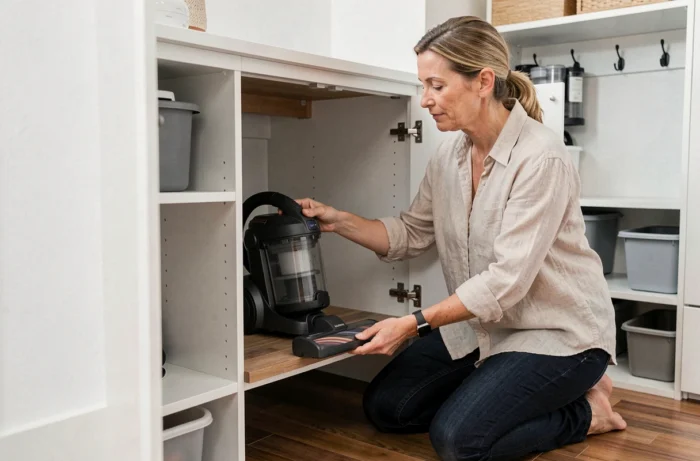
The most common reflex is to place the vacuum on the floor. This is also the least efficient. A canister vacuum placed flat takes up almost the entire floor space of the closet. The result: there is no room left for the bucket, cleaning products, or broom.
Dedicated hooks and wall mounts
Installing a wall mount suited to the diameter of your vacuum’s tube immediately frees up the floor. A vertically suspended stick vacuum occupies less than a quarter of the floor space compared to a model placed flat. J-hooks, sold in packs at hardware stores, fit most handles and telescopic tubes.
For a canister vacuum, suspension is not realistic given the weight of the main body. However, the hose and accessories (crevice tool, parquet brush, extension) can be hung on the wall or inside the closet door using adhesive clips or magnetic bars.
Storage bars on the inside door
The inside of the closet door is a dead space in most homes. Installing a hook bar or a hanging organizer allows you to store:
- The vacuum accessories (brushes, tools, replacement filters) in pouches or clips, preventing the need to search for them each time
- Light cleaning products (sprays, microfiber cloths) on suction cup or adhesive hooks, freeing up the main shelf
- A small broom or dustpan, fixed vertically to avoid obstructing the door closure
Dedicated vacuum niche: a standard in new homes
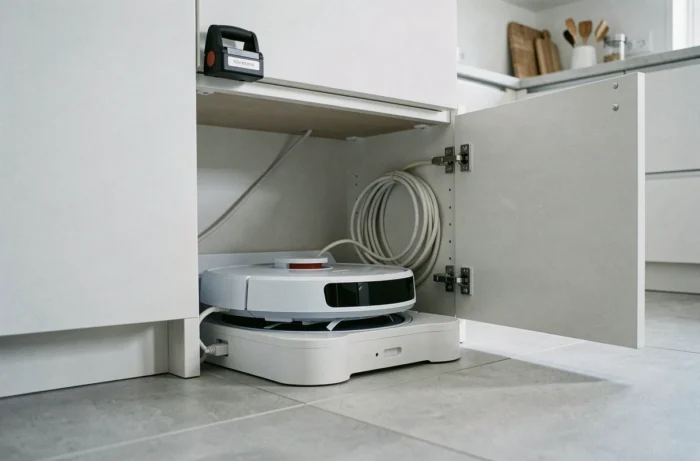
Have you noticed that some new house plans include a specific recess for the vacuum? Recently, French architects have been integrating a dedicated vacuum niche into housing designs, often under the stairs or in a hallway. This niche is designed to accommodate the device and its accessories, with a discreet door and direct access from the living areas.
If you are renovating, replicating this principle remains accessible. A recess of 40 cm deep and 60 cm wide is sufficient for most stick vacuums with their station. Plan for an electrical outlet at the back of the niche for charging.
Vacuum storage in a small space: zoning
Dividing the closet into vertical zones avoids the “everything in bulk” effect. The principle is simple: each category of item occupies a column or defined height.
Lower zone: the vacuum and the bucket
Reserve the lower third for heavy equipment. The canister vacuum slides onto the floor, with the bucket next to or underneath if the closet is deep enough. No light items should rest on the vacuum, which avoids having to move everything to access it.
Middle zone: cleaning products and accessories
A middle shelf, even if narrow, accommodates sprays, sponges, and filters. Labeled storage boxes by category (floors, windows, dust) allow you to find each product without rummaging.
Upper zone: rarely used items
The top of the closet is suitable for seasonal or infrequently used items: hose extensions, vacuum bags in stock, special products. Place them in a closed bin to avoid dust.
Storage mistakes that damage the vacuum
A poorly stored vacuum wears out faster. Wrapping the cord tightly around the body of the device weakens the wire at the connection point. Always leave a loose loop at the cable outlet.
Storing a vacuum with a full dustbin (bagless model) or a saturated bag encourages the proliferation of bacteria and emits odors in the closet. Empty the bin or change the bag after each cleaning session, not before the next one.
Storing the vacuum in a damp space (unventilated garage, unventilated basement) accelerates the oxidation of metal parts and can damage the motor. If your only available space is damp, place a moisture absorber nearby.
A well-organized closet for the vacuum requires neither heavy work nor a significant budget. The combination of a wall mount, a door organizer, and zoning transforms a chaotic space into functional storage, where each item has its place and remains accessible in seconds.